
Getting clients inside the thinking
Why the need for polished narratives keeps innovation projects behind closed doors, and how AI can help open them up
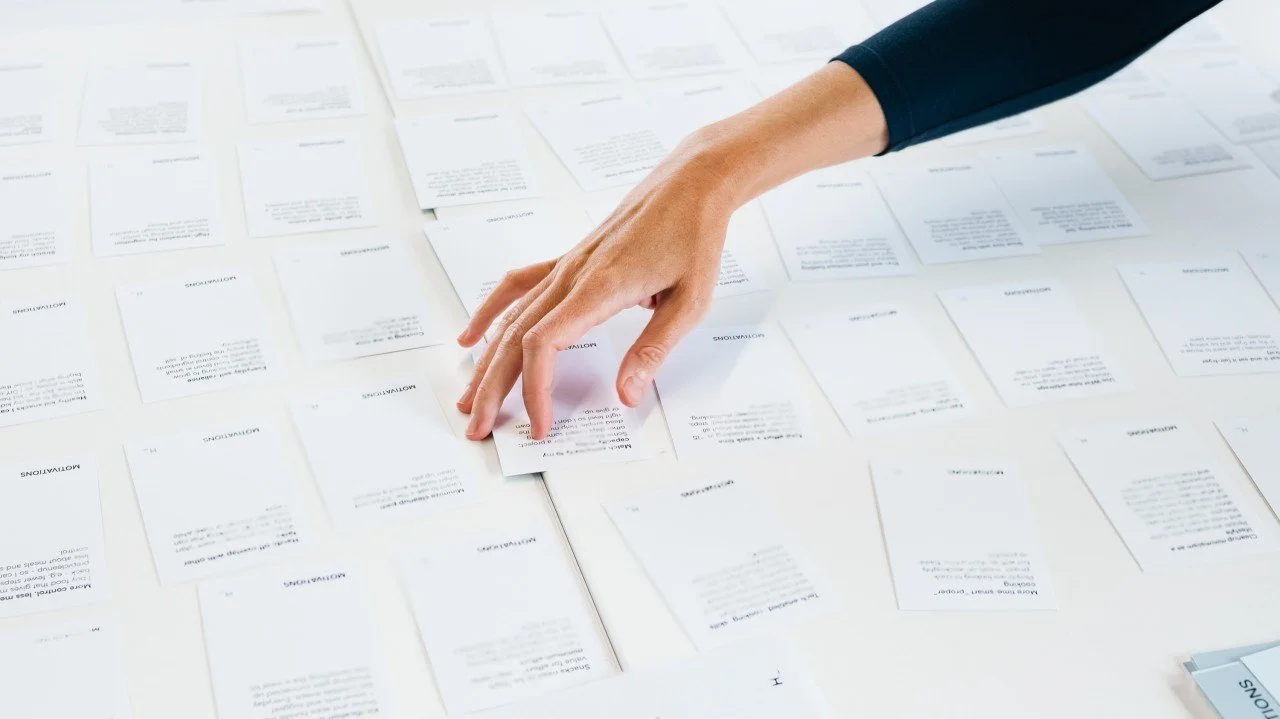
Credit: Eva Guerra (Hidden), workshop cards
A question for anyone who works in innovation or market research… If you were to go back and look at the work you did a year ago, which documents would you read?
Would you just go to the final presentation deck? Or would you dig into the raw material and workings out that you developed along the way?
I ask because we’ve come to think that over-reliance on final presentations is slowing innovation down. Instead, in our work, we’re deliberately de-emphasising decks in favour of long-form writing, knowledge maps, and prototypes. And we’re using tools like CoLoop and Signals that keep the evidence live and playable, so it doesn’t get locked up in fixed slides.
There are many reasons we avoid decks, each of which are probably worth their own article. For one, they’re not even designed to be read, they are meant to be presented - the fact they are often the default record of projects, is kind of nuts. Second, they’re a bit… mid. A bit… airport book. Not as detailed as proper writing but not a short summary either.
I might come back to those points in the future, but for now I’m going to focus on a different problem. That is, the biases that decks introduce, the kind of story they reward - highly polished, and broken down neatly into headlines - and the impact that has on the way teams work together.
The problem is not the polish itself, we love a good story. The problem is that polish requires decisions to be made: what matters, what doesn’t, which tensions to foreground and which to collapse. Making those decisions in public, with many voices, is slow and messy. It is far easier to have a small group of people in control of the story, even if they have to run a few workshops before properly settling in to write it up.
This all creates a pressure that is particularly acute on agencies. They are often judged, or might feel like they’re going to be judged, based on the quality of the story they tell. The deck is the visible artefact: it’s what gets circulated and remembered. So when polishedness comes to represent quality, agencies naturally optimise for it. Especially if they’re feeling a bit insecure about their level of influence or the esteem in which they’re held.
The irony is that this approach might make insights appear more compelling in the short term, but ends up resulting in them making less impact. Without deep client involvement they lack a certain substance. They’re less nutritious, they sustain less conversation. As a result, the thinking can struggle to travel internally. And when new questions emerge, the cost of reopening the narrative feels too high.
This might not matter too much when the research question is neatly bounded and focused on a single issue. A nice clear story works just fine. But when the client organisation is going through an inflection point, and needs to build a new foundation of thinking, then being able to use it again and again matters a lot more.
At that point, it’s important that the whole team feels close to it. They’re not just aligned with the conclusions: they have met participants, seen the clips, and wrestled with the tensions themselves, so the thinking has become theirs.
The difference AI makes
This is not a new problem (it’s always been better to get the whole team involved), but the challenge was a practical one: analysing raw evidence is extremely time consuming. For example, one of our recent projects had 48 hours of interview videos, very few clients are going to want to watch all of that.
Now, I’m pretty sceptical of A.I. in lots of situations, especially as a replacement for writing or real research, but in this situation it can really help. We’re using tools like CoLoop to make videos and transcripts easier to work and open analysis up. Instead of having to watch hours of footage, clients can ask questions, search for themes, and jump straight to relevant clips. This means more people can engage with the evidence, so sense-making can happen in the open without descending into chaos or taking too long.
We’ve also designed our own tool, Signals, to help us spot patterns in a wider range of evidence, including desk research. It uses a series of agents to conduct analysis, based on frameworks we’ve developed, and generate a wide range of example ideas for us to play with.
Crucially, this doesn’t remove the need for judgement, it changes the type of judgement being made. Instead of trying to write the best possible headlines for a deck, we’re working together to figure out all the connections. A bit like we’re building a world with the whole team, which we’re then going to explore together.
We still end up producing a deck - clients still have leadership meetings, after all - but we also produce a long report (one of them was 50K words, almost a book), we produce workshop cards and prototypes, and we encourage everyone to keep using the tools and asking questions of the raw evidence. In our experience, this opens up a much more collaborative way of working, in which everyone takes responsibility for where we get to, and everyone is committed to the work making an impact in the organisation.
Then, in the future, when someone goes back to look at the work again, they don’t just read the final deck, they explore all the thinking and add to it. Over time, instead of being broken up into discrete projects, all the data and insight becomes a connected living system. And by standing on the shoulders of earlier discoveries, innovation teams can start to move much faster.